Article for:
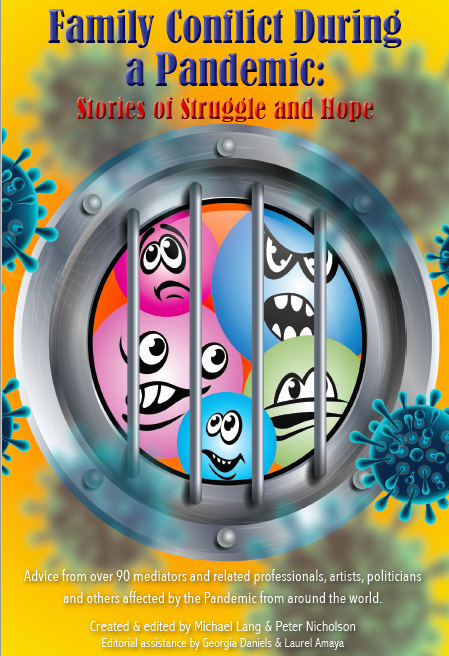
“Family Conflict During a Pandemic: Stories of Struggle and Hope”
A Non-profit publication led by renowned mediation expert Micheal Lang to help families affected by the Covid-19 Pandemic. With over 90 professional contributors across the world the book provides tips and guidance for families with proceeds of sales going to family charity organisations across the globe. For more information go to www.pandemic-relationships.com
by David Gray 2021
Job Description: Be Your Own Family’s Conflict Manager
Background:
Your situation is unique, nobody has the insight, experience, or understanding of the people and circumstances involved better than you. So it stands to reason, with the right skills, you are well placed to manage conflict, right? is story features skills found in mediation that real-life families used to overcome tough times themselves. The family I am about to tell you about inspired me in how they overcame their own issues even though the two parents who came to me for mediation were locked in dispute. For months beforehand they had stopped speaking and refused to cooperate with each other but as we progressed through mediation both parents awoke their own conflict resolution skills. You can manage your own family’s conflict, even if you are directly involved in the dispute itself. Here’s how:
Create a safe space to address disputes
Firstly, both parents were arguing in front of others and their children were caught in the cross fire. Fights would break out at any time, without warning, and escalate quickly. Both knew that they needed to communicate more effectively. They create a system of texting each other when there was a need to speak about a parenting issue. In the text, they suggested a suitable time and place to talk. They agreed with ‘Ground Rules’ such as no interrupting, mutual respect, confidentiality, and that the discussion was limited to the needs of the children. It took practice but the system took hold and conflict became more manageable.
Develop and use a toolkit for problem-solving
During mediation, it became apparent that the two parents often ran into a cul-de-sac whenever tackling an issue. In particular, their eldest son was having trouble at school and both parents struggled to find a way forward. This was particularly hard during the pandemic. Their resourcefulness was amazing. They used their ingenuity and developed options that were positive and creative. They researched online for evidence-based resources such as worksheets and apps that their child could engage with. They spoke to a local family and mental health support service who engaged remotely through phone support and video calls. They relied on their wider families to help more and one uncle mentored the young boy while fishing and farming.
Guide and assist towards resolution
Mediators will be familiar with the phrase ‘roll with resistance’. Our separating couple often could not get past the entrenched position the other parent took and often arguments came down to a battle of wills and ended in a sense of victory/loss or stalemate. This, of course, makes resolution more difficult. These parents did two things: Firstly they changed their view of the differences between them. Rather than seeing the other person’s unreasonableness, they treated their differences as boulders on a road that blocked their pathway. By viewing things this way they lessened the blame and personalisation of issues. The boulders analogy helped them focus and jointly work towards a resolution. Secondly, they asked themselves ‘What can I do this week to make things better?’. By doing something however small, each week the cumulative effect was transformative. Simple gestures helped the process move forward, e.g. offering to do a school run or helping with the children’s homework, etc.
Identify and develop areas of agreement
Rather than just focusing on the areas where they disagreed both parents worked hard to emphasize where they agreed as well. They both agreed that separating would mean a better quality of life for all. They agreed that they had to work hard to get there, they agreed that mediation was the best way to achieve that and that the best interests of their children came first. From those agreements, they developed a mediation settlement that worked for everyone.
Already throughout your life experience, you have the competencies listed above. Like the parents in this story, you can manage your own dispute, even during the pandemic. Trust the skills that you have to do so.
Webinar with Mills and Reeve (Solicitors U.K.) for:
Family Conflict During a Pandemic: Stories of Struggle and Hope
Interview with Michael Lang for:
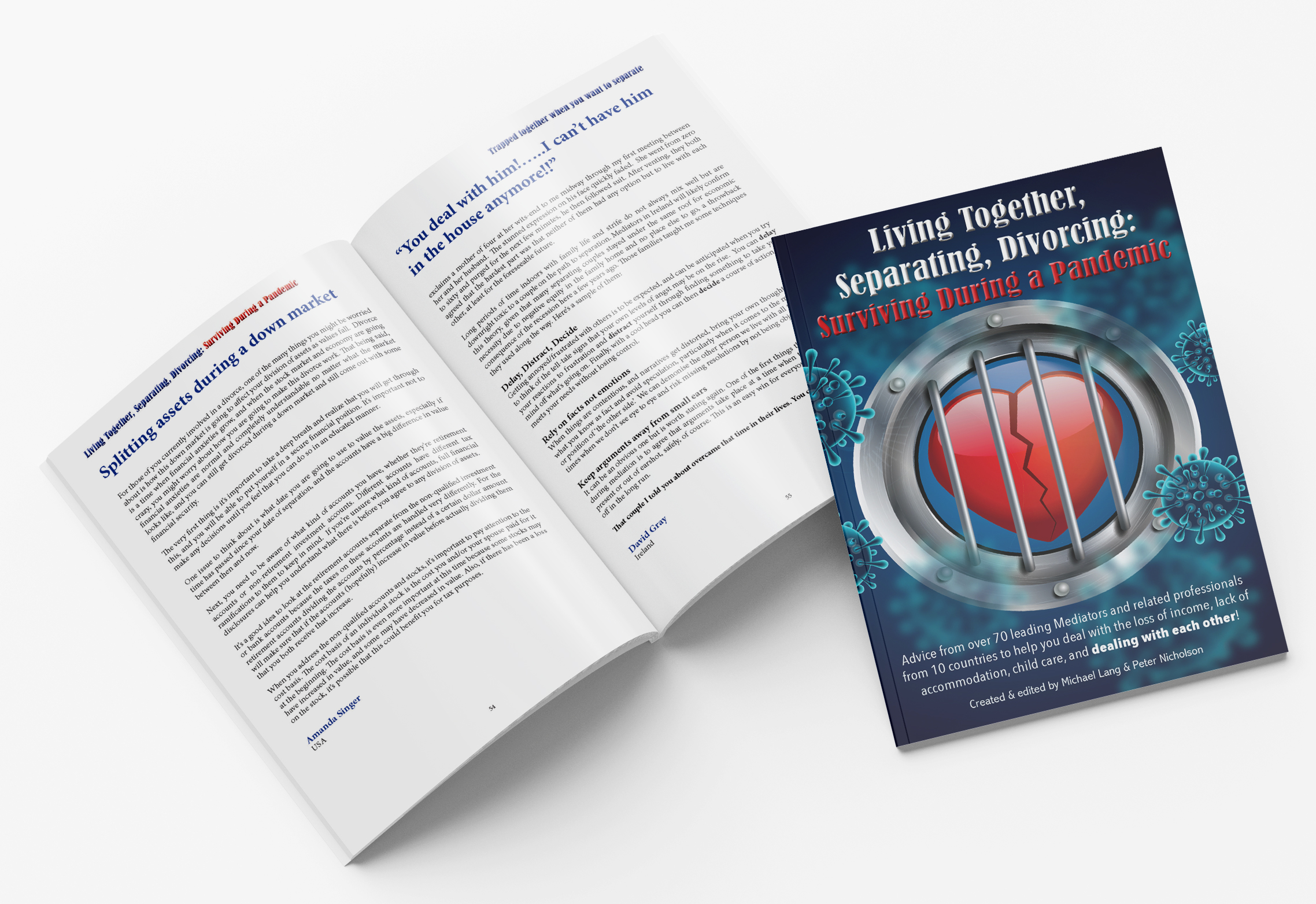
“Living Together, Separating, Divorcing: Surviving During the Pandemic”
August 2020. David Gray. Copy write permission given to Micheal Lang
Article for:
“Living Together, Separating, Divorcing: Surviving During the Pandemic”
A Non-profit publication led by renowned mediation expert Micheal Lang to help families affected by the Covid-19 Pandemic. With over 70 professional contributors from 10 countries across the world the book provides tips and guidance for families with proceeds of sales going to family charity organisations across the globe. For more information go to www.pandemic-relationships.com
by David Gray 2020
“YOU DEAL WITH HIM!…..I CAN”T HAVE HIM IN THE HOUSE ANYMORE!!” exclaims a mother of four at her wits-end to me midway through my first meeting between her and her husband. The stunned expression on his face quickly faded. She went from zero to sixty and purged for the next few minutes, he then followed suit. After venting they both agreed that the hardest part was that neither of them had any option but to live with each other, at least for the foreseeable future.
Long periods of time indoors with family life and strife, do not always mix well but are downright toxic to a couple on the path to separation. Mediators in Ireland will likely confirm this theory given that many separating couples stayed under the same roof for economic necessity due to negative equity in the family home and no place else to go, a throwback consequence of the recession here a few years ago. Those families taught me some techniques they used along the way. Here’s a sample of them:
DELAY, DISTRACT, DECIDE
Getting annoyed/frustrated with others is to be expected, and can be anticipated when you try to think of the tell-tale signs that your own levels of angst may be on the rise. You can delay your reactions to frustration and distract yourself through finding something to take your mind off what’s going on. Finally with a cool head you can then decide a course of action that meets your needs without losing control.
RELY ON FACTS NOT EMOTIONS
When things are contentious and narratives get distorted, bring your own thoughts back to what you know as fact and avoid speculation, particularly when it comes to the motivations or position of ‘the other side’. We can demonise the other person we live with all too easily at times when we don’t see eye to eye and risk missing resolutions by not being objective.
KEEP ARGUMENTS AWAY FROM SMALL EARS
It can be an obvious one but is worth stating again. One of the first things that I ask couples during mediation is to agree that arguments take place at a time when the kid(s) are not present or out of earshot, safely of course. This is an easy win for everyone and always pays off in the long run.
That couple I told you about overcame that time in their lives. You can too!
Ends, May 2020, David Gray. Copy write permission given to Micheal Lang
Submission following May 2019 Divorce Referendum:
“Divorce Referendum Results: What does it mean for Carlow, Kilkenny?”
by David Gray 2019
The close relationships we have in our lives often face challenges for a variety of reasons. A breakdown of those relationships can be traumatic for all sides involved and equally painful for children and others indirectly caught in the cross-fire. What is the likely impact of the recent referendum result and what it could mean for Carlow, Kilkenny.
According to the Circuit Court Service in 2017 just under 4000 applications for divorce were made in 2017. In Carlow and Kilkenny the figures rose from 111 applications in 2016 to 155 in 2017, representing a 40% increase, with the passing of the referendum this number looks set to grow.
In May (2019) the constituency of Carlow, Kilkenny voted 63.50% in favour of changes to the regulation of divorce, paving the way for a reduction in the amount of time a separating couple will have to wait for divorce. Under the existing legislation a couple must have separated for four of the previous five years on the date of commencing divorce proceedings. Shortly the government will take steps to reduce the waiting time down to two of the previous three years.
With the new changes commentators have said that the reduced waiting times will allow a separating couple ‘move out of limbo’, reduce the stress and collateral damage that accompanies the often painful process of divorce. When compared to the courts process mediation is quicker, keeps the separating couple in control, is significantly less costly and has a proven agreement rate of over 80%. As a result mediation can greatly reduce the anguish and strain separating couples can experience through the courts.
Ends © 2019, David Gray. All Right Reserved
Article:
“Constant battles with your teen can negatively impact on family relationships. Careful communication with them makes all the difference.”
by David Gray 2018
“Enjoy it while it lasts” is a phrase I heard often during meetings with so many parents who came to me for support with their teens. They say this when I tell them that I have two kids who haven’t yet reached the teenage years. Parents utter those words to me tinged with a longing for peace between them and their teenager often after months of arguments and I am inspired by how hard those parents then work to ‘get through’ to their teen child on issues like time online, getting on with siblings, school performance, or socialising safely to name a few.
With a boy of my own about to turn 13 I can see that I have to change my modus-operandi as he wants to be treated more and more adult-like. I can’t tell him what to do in the same way anymore, nor should I. From now on its about giving him choices, responsibilities and negotiating to reach a deal that works for my need as a parent and his need as a young man. It’s time to practice the message I have given to all those parents who tried everything from shouting matches to punishments. It’s time to practice what’s called ‘alternative dispute resolution’ when we disagree with our teens.

Of course no one becomes an oppositional teenager the second they turn 13 but certainly, perhaps painfully for many parents, their baby isn’t their baby anymore as they progress through those years of turmoil and change and parents need to become more strategic in communication as a result. No longer is obedience automatic (if it ever was) but in the teenage years and beyond the value of getting a shared agreement on important issues is crucial. Let me introduce you to an approach that minimises fighting, develops respect and result in a win for you and your teen without giving in to pressure or compromising on safety.
Forming the base to move on through genuine listening
In family sessions I have so often been told by parents how their son or daughter won’t listen anymore. Out of answers these parents experience anxiety, anger and frustration on a daily basis. It’s a small surprise when I tell them that at in many ways their teenager is likely feeling the very same. But this is good, it forms the basis of a shared Interest to change, in other words both sides have a common need to stop the pain that each other is feeling. The first step to achieving this is through hearing just how certain behaviours impact on the emotional wellbeing of the other. This is achieved through creating time, space and enabling real listening. Both sides will have to hear each other entirely and thoughtfully. This process can be supported by an independent professional skilled in family dispute resolution. In sessions I have seen the most oppositional teenager suddenly realise the full extent of their actions and take this learning on board when the process is managed correctly. Listening is the essential first step.
Tackling Each Problem Together
The second step is then to re-programme how both sides address real-life problems where parents and teenagers have very different ideas on how things should be done. This is achieved by building on step one and creating an agreed new way of communicating. For example a teenager may wish to be out until 1am every Saturday night, the parents expect a much earlier time. Rather than get into a battle of wills it is possible for both sides to say that while a good social life is important safety is a priority and it on that basis that times can be negotiated, regular phone calls are made, incentives for alternatives are agreed and so on. Giving ownership and responsibility to your teen to come up with solutions is a key feature of getting buy-in. It is hard to object to an idea if your son or daughter has had a role in developing it.
Finally it’s about putting the new way into practice, constantly working in communicating respectfully and meaningfully. This can be achieved through checking-in with each other on how things are going, hearing problems each side may have in implementing the changes and adjusting accordingly. If both sides resist the urge to blame each other for failures, past or present, the future becomes a shared one and life that much easier.
Ends. © 2018, David Gray. All Right Reserved
Article:
“Paying Lip Service to Cutting Teeth:A Conflict Resolution Student Raised by a Village of Mediators”
Written for the Edward Kennedy Institute; Maynooth University, 2016 by David Gray
Getting to Mediation Basecamp
Death by roleplay is a distinct possibility when studying and training in any form of Alternative Dispute Resolution and rightly so, after all the modern mediator needs to pilot the simulated mediation process before being handed the controls of a jumbo-conflict jet caught in stomach churning turbulence. But crossing the threshold of dress rehearsal dispute resolution to real people with real problems, is, many a commentator has said, now about “Senior Hurling”* and should be treated accordingly to say the least.
I should point out that I considered myself ready to seamlessly transition from the safety of my academic pursuits to full-on live mediation. After all I was a mediation master’s degree student, not only that but for the last ten years I worked as a community based drugs and family worker and often found myself involved in the most challenging, conflict ridden situations, there was nothing that would surprise me, right? But this is where mediation sets itself apart, shines and exposes such arrogance and naivety. The conflict that exists between disputing parties was not what caught me off guard but rather how mediation maintains its integrity and is stronger as a result in the hands of dedicated mediators. Until this point in my career I was guilty of paying lip service to important aspects of my work that would make me a better practitioner.
My placement in a voluntary community mediation service came at the latter stages of my studies. I thought I knew enough to sit confidently among my colleagues and dazzle with my years of related experience. I have no idea what their first impression of me was, but what I did not also realize was that this group of people were pure mediators and that first impressions were actively avoided. This group of people did not judge or form premature opinions, they practiced skills that I thought I understood but soon found out I had a limited acquaintance with, such as reflective practice, active listening and emotional intelligence. They worked with clear boundaries and with the aid of dedicated support and supervision and it all translated into a professional service benefitting the local community.
On my first day with them I was privileged to witness my first ‘Sharing and Learning’ group reflection of a recently mediated case. Following a format that had clearly been tried and tested the room of mediators listened as two volunteers detailed the background and subsequent mediation of a dispute. Following the detailed description provided, the audience of mediators asked questions of the two co-mediators the nature of which were searching, exploring and analyzing the case from a range of angles, both affirming and challenging. Hypothetical options were discussed and finally the session closed with the two mediators and the group feeding back on what they learnt. To me it was a river of learning already and I was simply sitting on the riverbank.
The next stage in my mediation upbringing was to observe the mediation of a separating couple. At this point my preconceived notions of this experience were on thin ice. The two mediators who were charged with this case also accommodated my needs and for four sessions I sat quietly, politely in the corner taking in the value of professional mediation practice delivered with such competence in an emotionally charged and consequently unpredictable scenario. I should once again stress the impact high emotion can have on someone as suggestable as me but the two mediators who showed empathy alongside dedication to the mediation process they maintained absolute multi-partiality. Despite all the angst and acts of desperate behavior that were aired during the sessions the co-mediators performed to better serve the two people who came to them for help and also the family’s children, not present in the room, but whose lives were also affected by the breakup.
Following the Sherpa’s of Mediation
The greatest compliment I can pay to the co-mediators of the separating couple case is just how much time I spent reflecting back on our discussions which took place after each session. To this day I still think of the explanations and insight I gained after the parties left and we had an opportunity to immediately go back over what had transpired, test hypothesis and debrief. Again this is something that I rarely experienced in other spheres of similar practice. It is logical to look back and learn from what you have just experienced, sounds obvious, but if you do not do this regularly, quite soon you won’t do it at all.
Now it was time to take to the mediation hot seat myself and at this point I found myself in the diligent care of my mediation mentors and following the lead of my mediation partners, all of whom were inspirational in the nuggets of mediation gold that they gave to me so selflessly. Two community cases arose, one centered around a neighbour dispute over a barking dog, the other concerned two disputing families where acts of violence and threats had subsided and the disputants all looking to move on. As said earlier role-plays can do so much but to be guided in the way I was during my first mediation cases made everything fall into place, sooner or later I had to sink or swim with real mediation but nobody was going to let me sink.
I learned the value of detailed preparation over a cup of coffee with my co-mediator. I learned to expect the unexpected with my mediation mentors. I was encouraged to explain the mediation process to the disputants as a “sales pitch” so that they could see what was in it for them, what a brilliant and novel approach. Needless to say I gained so much from the disputants themselves during the discussions but I could now see things through my new mediation lens and I could see what they weren’t saying as well as their body language and reading the non-verbal communication with my co-mediator as we quickly got ourselves in sync. In another case I was given access to my fellow mediation students and with the help of my lecturer we assessed the appropriateness of mediation in a unique dispute.
The value of mediation is not limited to a successful agreement, and while the cases themselves never got to agreement, (at the time I was quiet disappointed) I can say without doubt we provided so much to all the disputants, we helped them come to terms with their dispute, empowered them to become unstuck and lessened the suffering they all had and possibly will endure by giving them a new story and perspective. My mentors helped me see this, gave me the confidence to accept that I had performed to my best and that the disappointment I felt was a good thing because it showed I cared. During our mentor sessions one mentor mediated between me and my demons of negativity and he held up a mirror to the skills I practiced, not roleplayed or read about, but applied in a real-life mediation process. All this brought me further along the road to being a stronger mediator.
The Road is Rocky but the View is Worth it
I am glad to say I am mediating sometimes solo but also with the support of a co-mediator and having the wisdom to know when to do so is also something I picked up along the way. My experience over the last few months has gotten me here and I have some many people to thank. I feel more confident in my abilities, I feel safe and I trust in the mediation process. I can apply what I learned as a life skill, and I can pursue the highest standards of professionalism knowing that those who helped me along on this journey do the very same all the time.
Ends. © 2018, David Gray. All Right Reserved

 talklistenresolve.com